Building Trust with Data: Privacy-First Architecture for RPM Platforms
Design remote patient monitoring platforms with privacy at their core. Explore architectural patterns, data minimization principles, consent management, and transparency mechanisms that build user trust.
As healthcare moves from the hospital to the home, the security perimeter shifts from physical building access to digital data flows. For Remote Patient Monitoring (RPM) platforms to succeed, privacy cannot be an afterthought; it must be the foundational architectural principle. Patients need assurance that their intimate physiological data—blood pressure trends, cardiac rhythms, and oxygen levels—remains secure and under their control.
Here are the core architectural and design strategies for building privacy-centric monitoring ecosystems.
1. Architectural Patterns for Security
The most secure data is data that never leaves the patient's control unnecessarily. Modern RPM architectures are moving away from centralized "data lakes" toward more distributed, secure models.
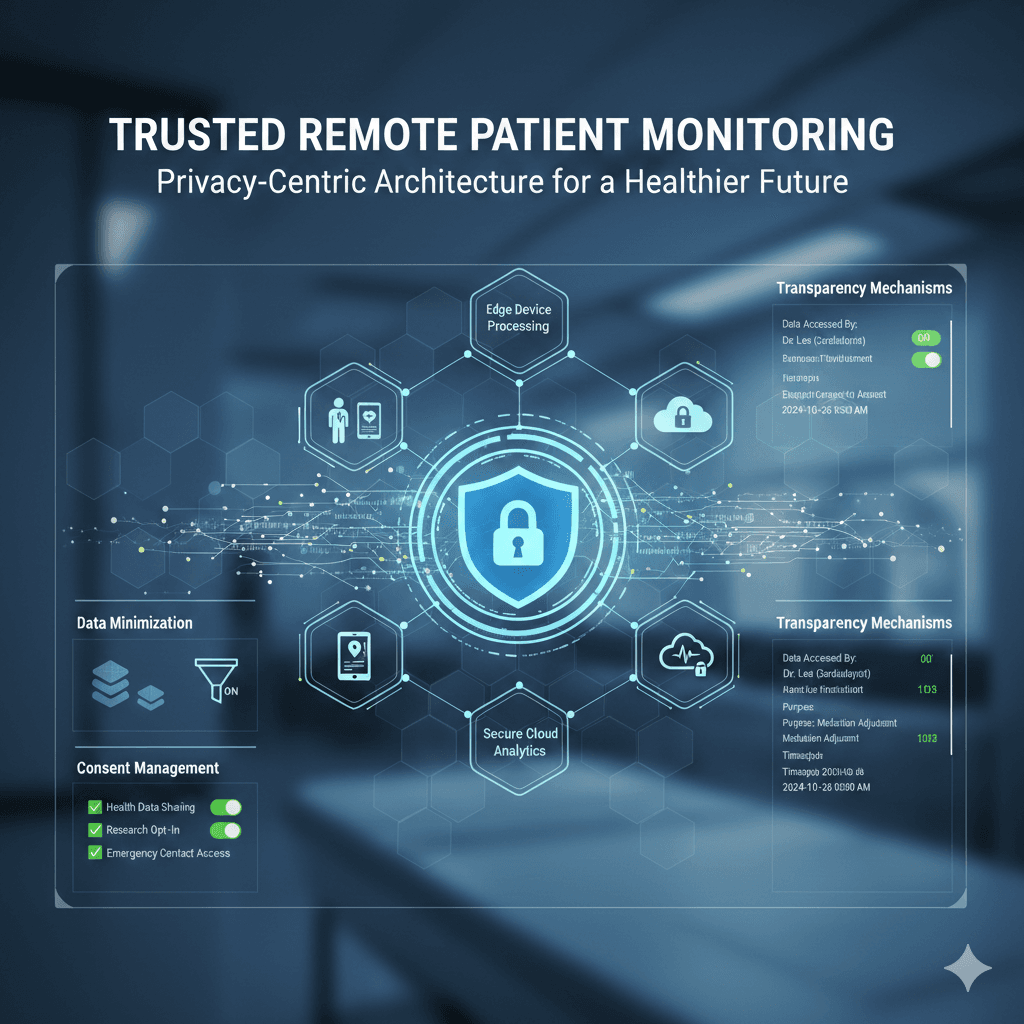
- Edge Computing & On-Device Processing: Instead of streaming raw, high-frequency sensor data to the cloud, perform initial processing on the "edge" (the patient's smartphone or the home hub). For example, a local algorithm can analyze an ECG for arrhythmia and only transmit specific flagged events rather than the continuous 24/7 waveform, significantly reducing the attack surface.
- End-to-End Encryption (E2EE): Data must be encrypted not just "at rest" and "in transit," but specifically encrypted in a way that the platform provider itself cannot view the clinical content if not authorized. Only the patient and the authenticated clinical team should hold the decryption keys.
- Zero-Trust Network Access: Assume no device or user is trusted by default. Every request to access patient data—whether from a doctor’s tablet or a backend API—must be rigorously authenticated and authorized for that specific session.
2. Data Minimization Principles
The principle of "collecting only what is necessary" is critical for reducing liability and protecting patient privacy.
- Purpose-Bound Collection: configuring devices to transmit only the data required for the specific care plan. If a patient is being monitored for hypertension, the system should strictly collect blood pressure and heart rate, while actively disabling or discarding extraneous data points like GPS location or microphone audio from the mobile hub.
- De-Identification by Default: Separating Clinical Data (vitals) from Personally Identifiable Information (PII) at the point of ingestion. The database storing blood oxygen levels should use an anonymized ID that can only be linked back to the patient's name via a separate, highly secured lookup table.
- Retention Policies: implementing automated data expiry. High-resolution diagnostic data may be needed for acute recovery (e.g., 30 days post-op), but should be automatically summarized or deleted once the immediate clinical need has passed.
3. Granular Consent Management
Consent in a digital health setting must be dynamic, not a one-time checkbox. Patients should feel they have agency over who sees their health metrics.
- Module-Level Permissions: Users should have the ability to grant access to specific data streams. A patient might consent to share weight and blood pressure with their cardiologist but choose to keep their sleep patterns or body temperature private.
- Time-Bound Access: enabling "temporary access tokens" for specific scenarios. For instance, granting a visiting nurse access to historical vitals for a 48-hour window, after which access is automatically revoked.
- Easy Revocation: The interface must provide a clear, simple mechanism for patients to withdraw consent or "disconnect" a specific device from the clinical dashboard instantly.
4. Transparency as a Feature
Trust is built through visibility. The platform should provide the patient with a clear window into how their data is being utilized.
- Patient-Facing Audit Logs: Just as a bank app shows a history of transactions, an RPM app should show a history of data access. A patient should be able to see exactly who viewed their ECG results and when (e.g., "Dr. Smith viewed your report at 2:00 PM").
- Plain Language Policies: Privacy policies and data usage agreements should be presented in simple, non-legalistic language within the app interface, explaining clearly where data goes and who has access to it.
Summary: The Privacy Advantage
In an era of frequent data breaches, privacy is a competitive differentiator. A remote monitoring platform that demonstrably protects user data through rigorous architecture and transparent design does more than just meet regulatory compliance (like HIPAA or GDPR)—it encourages higher patient engagement. When patients trust the system, they are more likely to use their devices consistently, leading to better data, better insights, and ultimately, better health outcomes.